![[MAA] Mirzadeh Architecture Association](https://keyhanmirzadeh.com/en/wp-content/uploads/2025/05/keyhanmirzadeh-logo2.png)

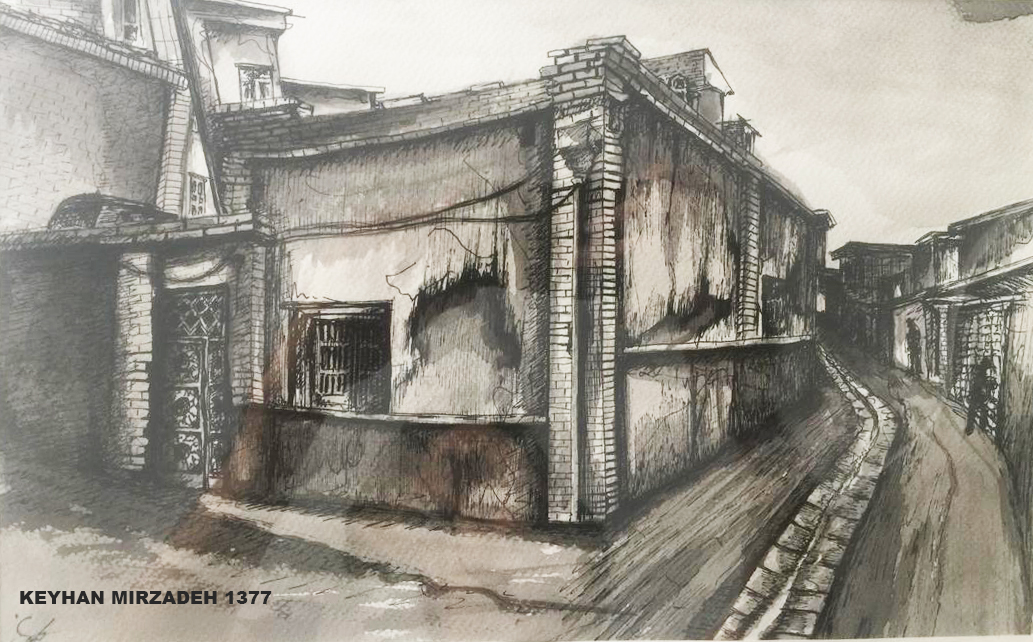
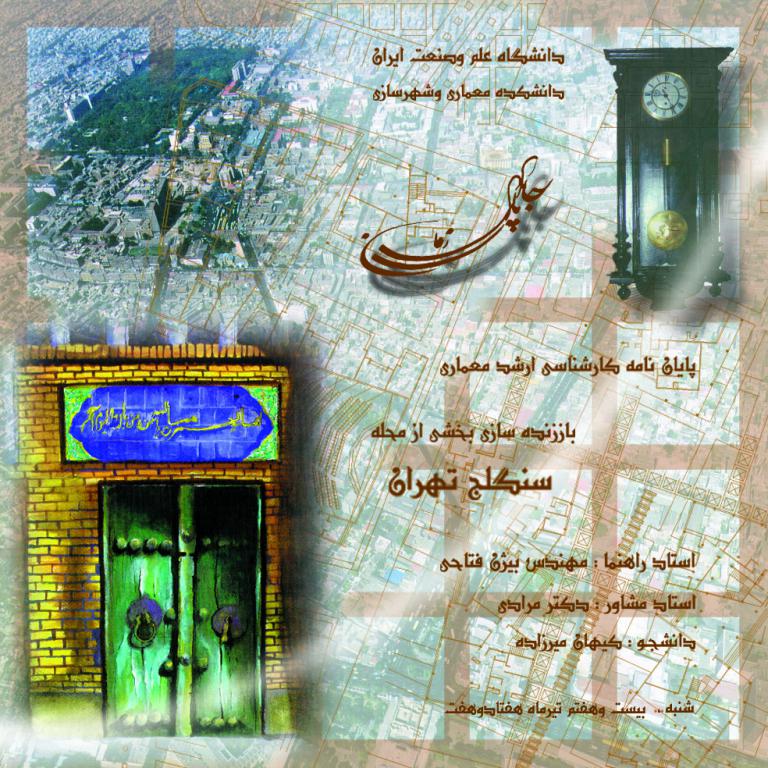
Footsteps of Time
Master of Architecture Thesis Project
Iran University of Science and Technology (IUST)
Faculty of Architecture and Urban Planning
Thesis Title: Revitalization of Tehran’s Sangalaj Neighborhood
Supervisor: Eng. Bijan Fattahi
Advisor: Dr. Asghar Moradi
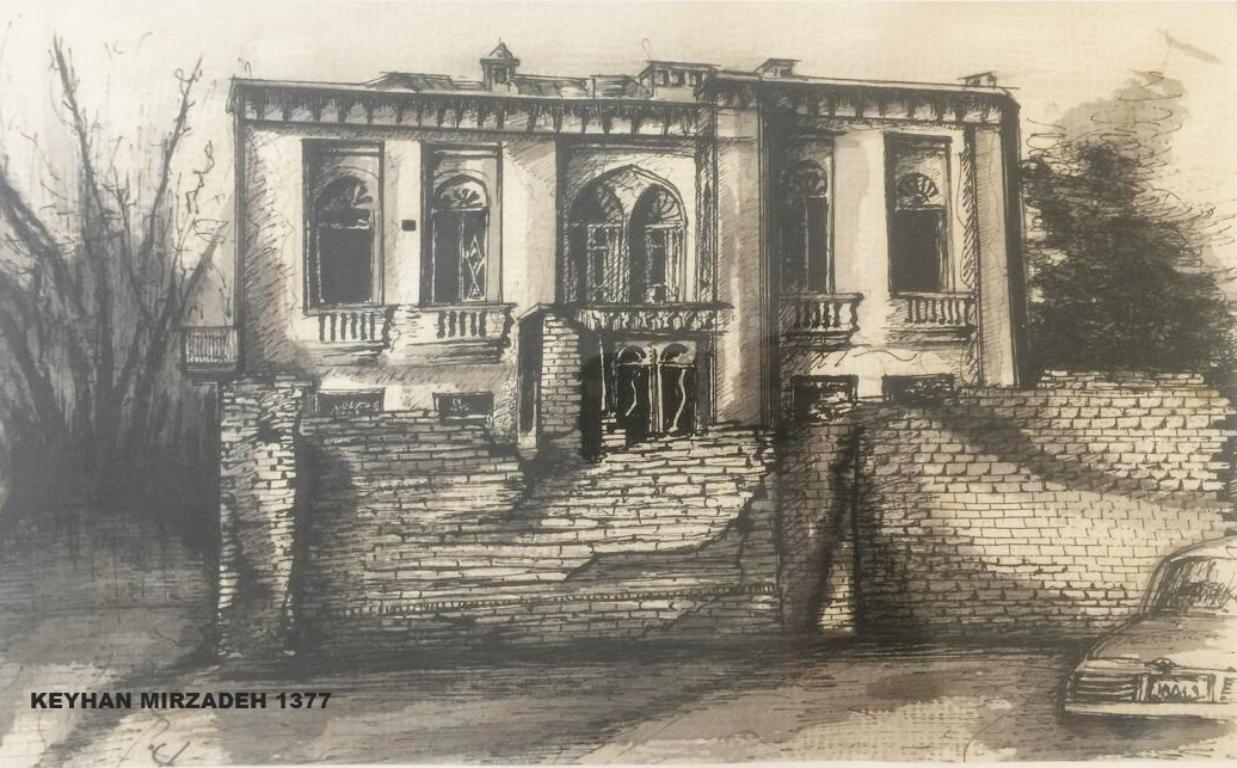
Student: Keyhan Mirzadeh
Date: July 18, 1998
Selected Project in “Memar” Journal, No. 3, Winter 1998 , Editor: Eng. Seyed Reza Hashemi
A 347-page copy is archived in the Faculty Library
Abstract:
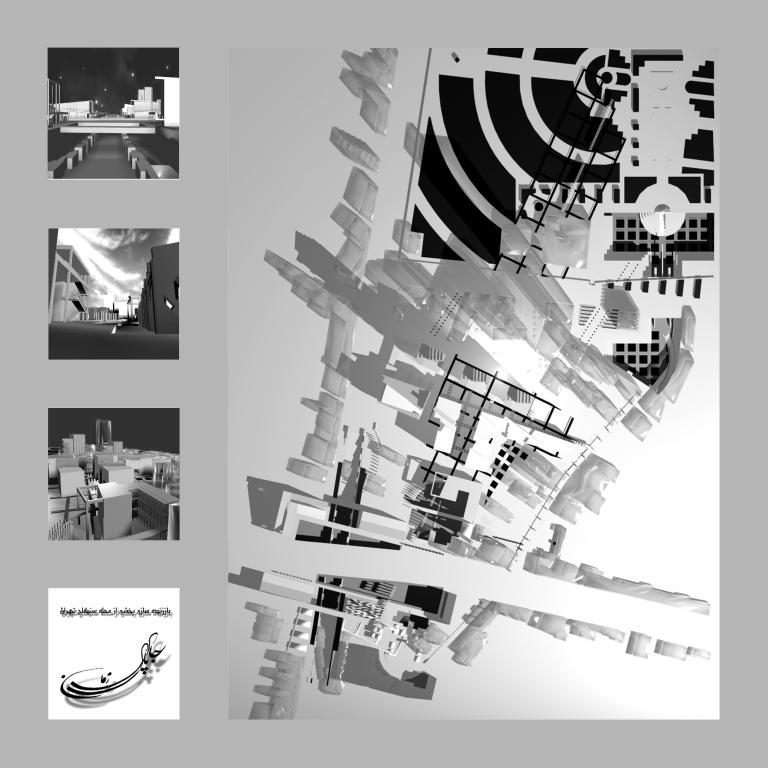
This Master’s thesis in Architecture explores the revitalization of Tehran’s Sangalaj neighborhood. After examining the area’s challenges, valuable urban elements, and connective axes, ideal solutions were formulated. Through data analysis and traffic flow optimization, the proposed design—supervised by Prof. Fattahi and Dr. Moradi—aims to restore lost urban values and spaces. Special acknowledgment to advisors Dr. Mansour Falamaki, Eng. Kamran Safamanesh, Dr. Nayer Ahmadi, and the late Dr. Mirfendereski.
Prologue:
History begins when shared aspirations unite people into tribes. All existence stems from desire, and collective boundaries form through culture—manifested in literature, visual arts, music, architecture, and urbanism. Cities embody a culture’s richest historical legacy: their layered fabric reveals evolving ways of life across eras. What endures are Footsteps of Time.
Historic events may fade into memory, but their physical settings persist. These resilient spaces preserve history, awaken collective memory, and manifest a city’s—and ultimately a nation’s—narrative. Unlike other art forms, cities uniquely converge historical moments into tangible spatial experiences.
Thus, ancient urban fabric forms a powerful repository of cultural continuity. This connection to heritage shapes national identity, linking past, present, and future. Only by embracing these values can we secure a hopeful tomorrow.
Methodology:
- Documenting neighborhood elements, axes, and heritage structures
- Proposing functional transformations to reactivate public spaces
- Designing integrated pedestrian/vehicular circulation systems
- Decentralizing incompatible functions from historic cores
Urban Planning Outcomes:
1- Increased per-capita green/public spaces
2- 24-hour residential reactivation
3- Culturally sensitive service zoning
4- Commercial corridor design extending from SabzeMeidan Square
5- Historic-industrial function relocation
Core Proposition:
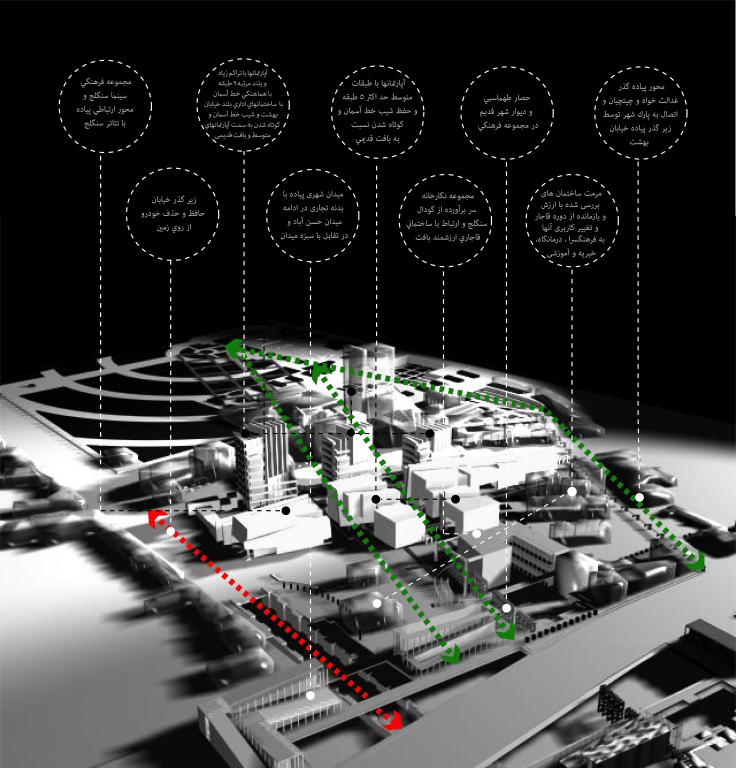
1.Creating a cultural axis connecting between new architecture and urban heritage
- Proposed Arts Complex (Gallery/Library/Exhibition spaces)
- connecting “Edalatkhah” Historic Alley to Park-e Shahr and National Garden Museum
- Reviving a 200-year-old wall from the Safavid era surrounding the city as a cultural spine
- Community housing design 300 unites (36 apartment typologies)
- Charitable-educational complex
- Design and Reactivated corridor between cinema- Sangelaj theater
Design Philosophy:
1- How can ‘City-as-Space’ become ‘City-as-Time’.
2- How can new architecture converse with heritage.
3- How do we verify solutions.
4- This project bridges historical memory and contemporary needs through layered placemaking.